Sunday, February 7, 2010

BSI February selection

An Outline of the Republic by Siddhartha Deb  is a murky atmospheric tale of shifting politics and emotional ambivalence.  Amrit Singh, a nonpracticing Sikh and atheist, works half-heartedly as a journalist at a Delhi-based English language newspaper, The Sentinel.

In The Sentinel's news morgue, Singh stumbles across a photograph of two insurgents and their hostage, a young woman to be assassinated for being a porn actress. Singh journeys to the border region between India, Burma and Tibet in search of information about the alleged porn actress.

The physical and emotional terrain of Outline projects the reader into an existential no man’s land. Heroes and villains are conjured from rumors and rumors of rumors. What is real and true about the young woman, the saintly but shadowy Malik and even Singh himself is never exactly settled. The reader is left to make his or her own conclusions.

Siddhartha Deb  is the author of two novels, The Point of No Return (2002), which was a New York Times Notable Book, and An Outline of the Republic (2005), known as Surface in the UK and India. Aside from two novels, he is a regular book reviewer and journalist for the New York Times, Boston Globe, The Guardian and others.

Deb won the 2007 Dublin IMPAC award for Outline. He is currently a Radcliffe Institute fellow at Harvard University and is working on Do You Know Who I Am? Stories of Wealth and Poverty from the New India, a nonfiction book dealing with contemporary Indian society.

Sunday, January 17, 2010

BSI January 2010 selection


The lost specimen of an extinct bird, 18th century love affair, a 20th century treasure hunt, and cryogenically preserved DNA.

Martin Davies’ debut novel, The Conjurer’s Bird, encompasses all of these components and tells a romantic tale which incorporates the real-life disappearance of the “mysterious bird of Ulieta”, a bird collected during Captain Cook's second voyage to the South Seas.

The novel hovers between two main characters and time periods: the 18th century naturalist Sir Joseph Banks and the fictional modern-day John Fitzgerald, a conservationist, taxidermist and researcher of extinct birds.

Davies’ novel manages to address both social issues and gender politics in the 18th and 20th centuries without losing its allure as an enjoyable easy read that will appeal to both men and women. A reader’s guide to The Conjurer’s Bird can be found here.

Fans of Servants of the Map by Andrea Barrett and Easter Island by Jennifer Vanderbes will thoroughly enjoy The Conjurer’s Bird.
For those who might prefer nonfiction treatment of the topics addressed, try Wanderlust: A History of Walking by Rebecca Solnit,  Joseph Banks, a Life by Patrick O'Brian or at websites here, here , here and here.


Monday, January 11, 2010

DATE January 2010 selection


Gustav Klimt. Emilie Flöge.

Which name rings familiar? If you’re like most people, artist Klimt’s name will fire the synapses and his famous painting, The Kiss, will come to mind.

Who Emilie Flöge was is a bit more occluded. She was a fashion designer, co-owner of a long-lived Viennese fashion salon, Klimt’s sister-in-law (her sister Helene married his brother Ernst) and Klimt's model.  Rumors persist that she was also Klimt's mistress.

In the vein of Tracy Chevalier's The Girl with a Pearl Earring, The Painted Kiss is a historical novel about Gustav Klimt and his muse, Emilie Flöge. Elizabeth Hickey's debut novel imagines (or illuminates, if you will) the relationship between Klimt and Flöge.

Little beyond bare facts is known about Emilie Flöge and the nature of her relationship with Klimt. She was the model for two of Klimt’s most famous paintings: The Kiss and The Portrait of Emilie Flöge.  Flöge and her sisters, Pauline and Helene, founded their fashion salon, Schwestern Flöge (Flöge Sisters), using many of Emilie's own designs.

In fact, Klimt and Flöge collaborated on dress and fabric design. Much of their joint work wound up both in Klimt’s paintings and in the clothing produced by Schwestern Flöge salon.

Hickey addresses exactly how much of The Painted Kiss is factual in an author’s note at the end of the book. Or here, just select Author’s Note from the drop menu.

The Painted Kiss is a good read. Hickey skillfully marries fiction and history. A reading group guide for The Painted Kiss can be found here.  Hickey is author of a second novel, A Wayward Muse.

Tuesday, December 15, 2009

DATE December selection


"I'm trying to write the stories that haven't been written. I feel like a cartographer; I'm determined to fill a literary void." --Sandra Cisneros in an interview.


The House on Mango Street by Sandra Cisneros is a collection of stories or prose poems with a single narrator.  Eleven-year-old Esperanza recounts the lives of her family and neighbors.

In The House on Mango Street, Esperanza speaks the yearning of Cisneros’s own childhood as well as of those—hispanic, black, poor, female, immigrant—who are least likely to have a voice in world.

Cisneros began writing the unwritten stories in response to a seminar during her time at University of Iowa's Writer's Workshop. Cisneros spoke about that time in a Publisher's Weekly interview:

"Everyone seemed to have some communal knowledge which I did not have--and then I realized that the metaphor of house was totally wrong for me. Suddenly I was homeless. There were no attics and cellars and crannies. I had no such house in my memories. As a child I had read of such things in books, and my family had promised such a house, but the best they could do was offer the miserable bungalow I was embarrassed with all my life. This caused me to question myself, to become defensive. What did I, Sandra Cisneros, know? What could I know? My classmates were from the best schools in the country. They had been bred as fine hothouse flowers. I was a yellow weed among the city's cracks."

"It was not until this moment when I separated myself, when I considered myself truly distinct, that my writing acquired a voice. I knew I was a Mexican woman, but I didn't think it had anything to do with why I felt so much imbalance in my life, whereas it had everything to do with it! My race, my gender, my class! That's when I decided I would write about something my classmates couldn't write about."

This experience, instead of discouraging Cisneros’ creative ambitions, emboldened her writing and illuminated a place for her to enter the literary fray. In 1984, The House on Mango Street was published by Arte Publico Press of Houston and won the Before Columbus Foundation's American Book Award in 1985. 

For Cisneros, a story is only a story if people want to hear it.  The House on  Mango Street's stories were based on oral storytelling. She constructed The House on Mango Street to be read in short bursts, in a form that did not require great tracts of time to absorb it. Her aim was to make it accessible to working people—to the people like the characters in the House on Mango Street. 

The novel uses its loose structure to explore the themes of individual identity and communal loyalty, estrangement and loss, escape and return, the lure of romance and the dead end of sexual inequality and oppression.


Cisneros is the author of four books of poetry: Loose Woman, My Wicked Wicked Ways, The Rodrigo Poems, and Bad Boys.  She has also written Woman Hollering Creek and Other Stories and a bilingual children’s book, Hairs=Pelitos. She is a contributor to Emergency Tacos: Seven Poets con Picante, Days and Nights of Love and War, and Family Pictures/Cuadros de Familia.  Her latest novel is Caramelo. An audio interview of Cisneros discussing Caramelo can be found here.


The House on Mango Street and other Cisneros’ other works are studied in schools and universities across the nation.

As Esperanza says at the end of The House on Mango Street:

“One day I will pack my bags of books and paper. One day I will say goodbye to Mango. I am too strong for her to keep me here forever. One day I will go away.

They will not know I have gone away to come back. For the ones I left behind. For the ones who cannot out.”

In keeping with her passion to provide a voice for the voiceless, Cisneros has founded the Macondo Foundation and the Alfredo Cisneros del Moral Foundation. The foundations offer writing workshops, residencies, and monetary awards to help further struggling writers’ efforts.

Both foundations offer writing workshops, residencies, and monetary awards to help further struggling writers’ efforts. The foundations’ collective mission and commitment is build community-building, to facilitate non-violent social change and serve underserved communities through writing.

Monday, November 30, 2009

BSI December selection


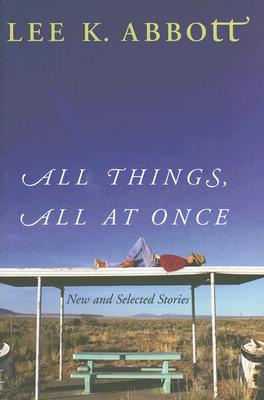
In All things, All at Once by Lee K. Abbott tries to live up to its title and doesn’t always hit the mark. Many of the stories are filled with main characters the reader never quite likes or tolerates: males cheating on wives and girlfriends; males whiskeyed up or wounded emotionally and spiritually from life, war or birth.

While the reaction to Abbott’s male characters may cause readers to feel the short story collection is uneven, the writing is good and solid. He creates a definite sense of place— mainly the Southwest, New Mexico—and time, whether the story takes place in the Sixties or now.

Likeable or not, most of Abbott’s characters feel real with their tendency to ramble, wheedle, talk and talk and talk. They talk about their fears of going crazy as in "The Way Sin is Said in Wonderland" ; about visits from extraterrestrials as in "The Talk Talked Between Worms"; about visitations from angels as in "The Human Use of Inhuman Beings"; and of course about women as in "Ninety Nights on Mercury".

Some of the short stories are connected, sharing characters, place or events freely as does real life with real people. These interconnected stories are the gems of All Things such as "The Human Use of Inhuman Beings" and "The Way Sin is Said in Wonderland". The stand-alone stories, "Dreams of Distant Lives" and "Gravity", also gleam with the characters' hard won strength and the excellence of Abbott’s creation.

Lee K. Abbott currently teaches creative writing at Ohio State University  in Columbus, Ohio. He has written six other books of short stories: The Heart Never Fits Its Wanting: Stories (1980), Love is the Crooked Thing (1986), Strangers in Paradise (1986), Dreams of Distant Lives (1990), Living After Midnight (1991), and Wet Places at Noon (1997).

Reviews of Abbott ‘s work and interviews with him appear here, here and here.

His work has often appeared in The Best American Short Stories and in publications such as Atlantic Monthly, Harper’s, The Southern Review and The North American Review.

Ultimately Abbott’s stories are, as Williams Giraldi describes, “an orgy of style, one that performs the magic trick of being at once inebriated and exact—his narrators akin to world-class drinkers who can down a fifth of Jim Beam and still stand straight".

Sunday, November 22, 2009

DATE November selection


Suspend your ideas about what makes a novel.

Heredity of Taste by Natsume Soseki is mythology and the personal musings of its narrator, which easily feels like the author's unadorned voice.

Soseki’s first and only anti-war novel opens with the mythological grandeur of a Wagnerian opera, then immediately recounts the human cost and aftermath of soldier Kosan’s death in the Russo-Japanese War of 1904–1905, narrated by Kosan’s unnamed friend.

Heredity of Taste is split into two parts. After a prologue of gods meddling into earthly affairs, Soseki presents an elegiac rumination on Kosan’s death and the victorious homecoming of his fellow soldiers at the central train station in Tokyo juxtaposed against the might-have-beens of Kosan’s life and an unknown young beauty encountered grieving at his grave.

The second section offers a somewhat hard-to-follow but fascinating dip into historical Japanese social hierarchy, western psychology, karma, ancestors and a dash of a detective-mystery story as the narrator tries to uncover the young woman’s identity.

One key to understanding Heredity is to substitute “attraction” for ‘taste” in its title. Another aid to understanding Heredity is the excellent introduction in the Tuttle Classics edition written by Stephen W. Kohl, Associate Professor at the University of Oregon. Kohl provides both historical and author context for Heredity’s setting and themes.

A fuller analytical discussion of Heredity of Taste can be found here.

Natsume Soseki is the pen name of Natsume Kinnosuke. Soseki, Japan’s Charles Dickens, is considered the foremost novelist of the Meiji period, which lasted from 1868 to 1912. He was pictured on the Japanese ¥1000 note from1984 to 2004.

Soseki’s most famous works Kokoro and Botchan are available online full-text and in English. Many of his works dealt with individual or personal desires versus group responsibilities and ties.

Although written in 1906, Heredity of Taste has a modern experimental feel. It proffers a microcosm of Japanese national character and gives a glimpse of a country on the cusp of melding the past with the future.


BSI November selection


October Light by John Gardner is not a light, easy read.

On the surface the novel centers on feuding geriatric siblings, James Paige and Sally Abbott. Younger brother James allows his down-on-her-luck widowed sister Sally to live with him, but after butting heads over politics and the morality of television, locks her in a room with a book.

Gardner uses October Light (and the novel-within-the-novel), set during the bicentennial, to comment about liberal and conservative American politics, racial bias and gender inequity as well as America’s past and future.

The novel is by turns ridiculous, laugh-aloud funny, intriguing, boring, genius and obscure--which is exactly how many critics and readers described its author, John Gardner (not to be confused with the British thriller writer, John Gardner). [Discussion questions can be found here.]

Once known as a sarcastic bad boy of literary criticism, Gardner is best known for his books On Moral Fiction and Grendel, a retelling of Beowulf from the monster’s perspective.

October Light won the 1976 National Book Critics Circle Award. Currently the National Book Critics Circle, a non-profit organization, consists of more than 900 active book reviewers who are interested in honoring quality writing and communicating with one another about common concerns.

Gardner spoke of his critique on the literary establishment (and their response) in On Moral Fiction in an interview with Don Swain and Gil Gross for Wired for Books little more than a year before his accidental death.

While it is difficult to truly recommend October Light, there are gems of excellent writing and great wit to be found in its pages. Gardner’s use of James and Sally’s intestinal complaints to symbolically illustrate the differences between liberal and conservative political thought as well as the laugh-out-loud first meeting of Father Hernandez and Sally through the bedroom door is worth the price of October Light’s numerous rambling passages.